The rapid advancement of artificial intelligence has transformed the way content is created in 2026. AI tools can now produce articles, social media posts, marketing copy, and even video scripts within seconds. This has led many businesses and creators to question whether AI-generated content can outperform content created by humans.
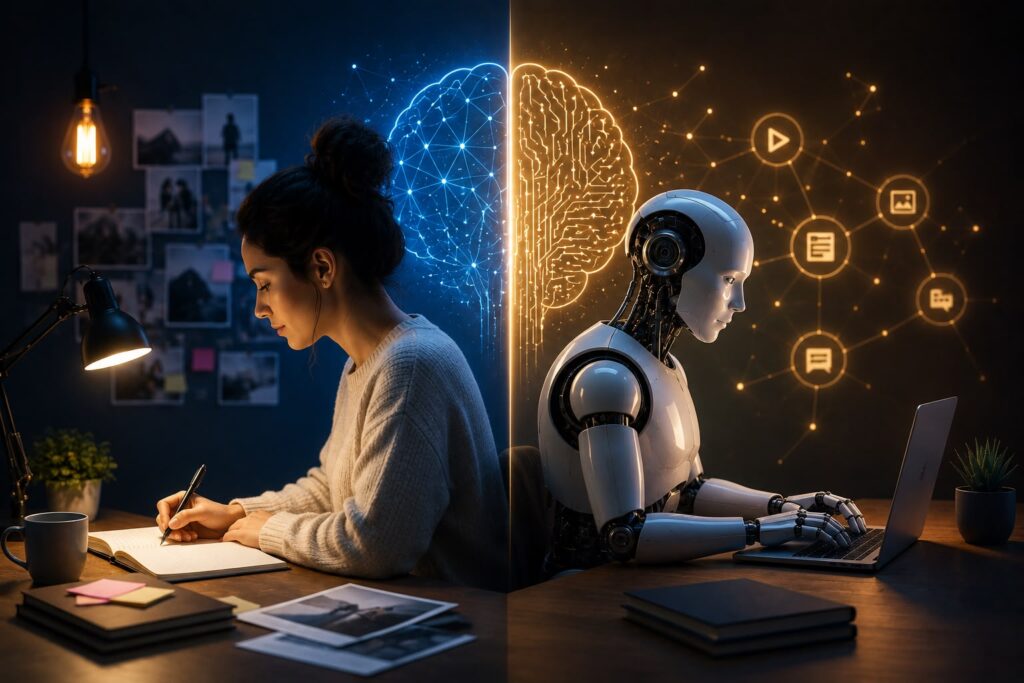
The reality is that both human and AI content have their strengths and limitations. The most successful content strategies in 2026 are not about choosing one over the other but understanding how each can be used effectively.
Best Digital Marketer in kerala
What Is Human-Created Content?
Human content is created using personal experience, emotions, creativity, and individual knowledge. It reflects a unique perspective that comes from real-world experiences, professional expertise, and personal storytelling.
Human writers can understand emotions, cultural trends, humor, and audience psychology in a way that machines still struggle to replicate. This ability allows human-created content to build stronger emotional connections with readers.
What Is AI-Generated Content?
AI-generated content is created using artificial intelligence models that analyze large amounts of information and generate text based on patterns and data. AI tools can quickly produce drafts, summarize information, suggest ideas, and help marketers increase productivity.
In 2026, AI has become a powerful assistant for content creation, especially for research, content planning, SEO optimization, and generating initial drafts. However, AI content often requires human editing to ensure originality, accuracy, and a unique brand voice.
Human Content: The Strength of Authenticity
One of the biggest advantages of human-created content is authenticity. Readers connect with personal stories, opinions, lessons learned, and genuine experiences that cannot be fully recreated by AI.
For industries that depend on trust, such as consulting, education, healthcare, and personal branding, human insight plays a major role in building credibility. Content with original ideas and personal experiences often creates a stronger emotional impact and encourages audience loyalty.
AI Content: The Power of Speed and Efficiency
AI’s greatest advantage is its ability to create content quickly and efficiently. Businesses can use AI to generate ideas, write outlines, analyze trends, and create large volumes of basic content in less time.
For routine content tasks, AI helps reduce workload and improve productivity. It is especially useful for brainstorming, keyword research, content optimization, and generating multiple content variations.
Which Content Performs Better for SEO in 2026?
Search engines in 2026 focus more on content quality, usefulness, and user satisfaction rather than whether the content was written by a human or AI.
Well-edited AI content can perform well if it provides valuable information and meets user needs. However, human-written content often has an advantage because it brings originality, personal experience, expert opinions, and a distinctive voice.
The highest-performing websites combine AI efficiency with human creativity. AI helps with research and structure, while humans add expertise, storytelling, and authenticity.
The Future Is Human + AI Collaboration
The debate between human and AI content is not about replacing writers. Instead, the future belongs to creators who know how to combine technology with human creativity.
A smart content strategy in 2026 uses AI as a powerful assistant while allowing humans to make the final decisions, add emotional depth, verify facts, and maintain a consistent brand identity.
Conclusion
Human content and AI content both have important roles in modern digital marketing. AI offers speed, scalability, and efficiency, while human content provides creativity, trust, emotion, and unique experiences.In 2026, the content that performs best is not purely human or purely AI—it is high-quality content that combines the strengths of both. Businesses and creators who balance AI technology with human expertise will build stronger connections, improve SEO performance, and stand out in an increasingly competitive digital world
Sources